
- AI-powered
- Scenario-based
- Custom animation
Brushstrokes & Lies
An AI-powered investigative mystery where learners question suspects, weigh evidence, and build a case of their own.
 Overview
Solve the case by asking your own questions
In this AI-powered investigative simulation, learners question two suspects after a valuable painting is secretly replaced with a forgery. To build a strong case, they must ask purposeful questions, identify inconsistencies, connect evidence across multiple sources, and use deductive reasoning before deciding whom to accuse.
 The Problem
Critical thinking without a script
Critical thinking is often taught through explanations or multiple-choice questions that already define the available options. In real situations, however, people must decide what information they need, formulate their own questions, evaluate the reliability of different sources, and reach conclusions with incomplete information.
I wanted to create an experience where learners could practice those skills without being guided toward the answer by predetermined dialogue choices. Although the project uses an art heist as its setting, the mystery is not simply a game — it provides a structured environment for practicing effective questioning, evidence analysis, and deductive reasoning.
 The Solution
An AI-powered mystery to investigate
I designed an AI-powered mystery simulation where learners step into the role of an investigator following the discovery of a swapped painting. They interrogate two suspects: Julian Vale, a painter assisting behind the scenes, and Adrian Cross, the gallery curator who called security and locked down the building after the swap was discovered. Rather than choosing from a list of scripted questions, learners type their own questions into two AI-powered conversations.
The information they uncover affects the evidence they receive later in the investigation. After reviewing what they have, learners select a suspect and present their conclusion to the district attorney — and the outcome depends on whether they gathered enough relevant information to support the accusation. The experience concludes with a newspaper-style outcome and AI-generated feedback based on the learner’s actual interrogation strategy.
The ProcessFrom crime scene to closing argument
Creating investment before the investigation begins
Critical thinking doesn’t happen in a vacuum — learners need a reason to start asking questions before they’re handed any information. So I began the experience with a short animated sequence showing a shadowy figure swapping the painting and fleeing the scene, rather than opening with a briefing or a list of facts. Starting with the crime itself creates immediate curiosity and prompts learners to form their own questions before Detective Ruiz tells them anything.
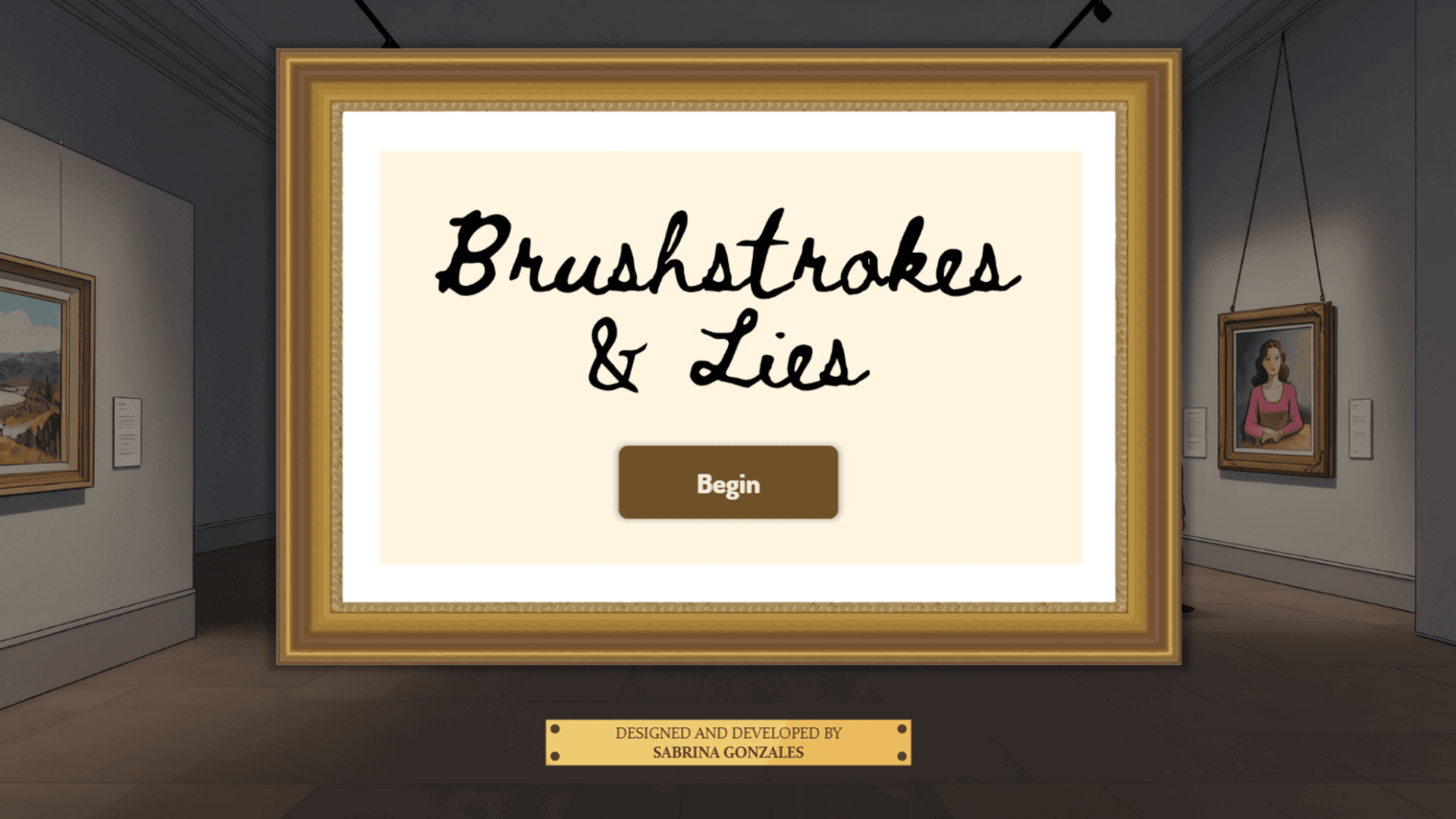
After the title screen, Detective Ruiz — a senior detective overseeing the investigation — explains what happened, introduces the two suspects, and notes that additional evidence is still being collected. She also introduces a notebook learners can use to record observations, a small structural cue that this is an active investigation, not a story being told to them. From there, learners reach a suspect-selection screen and choose whom to question first. That choice was intentional: real investigative reasoning starts with deciding where to look, not just how to respond once you’re told where to look.
Designing open-ended interrogations
The central interaction consists of two AI-powered suspect interrogations built with devlin.ai and embedded in Articulate Storyline 360. Learners can ask each suspect up to ten original questions rather than selecting from multiple-choice prompts. This open-ended structure is central to the learning: learners must determine which topics are relevant, phrase useful follow-up questions, recognize evasive or suspicious responses, and decide when they have enough information to move forward.
One technical challenge was making the two interrogations feel like parts of the same investigation, since the AI simulations operate independently and can’t see what happened in the other conversation. To create continuity, I gave each simulation shared scenario context — knowledge of the gallery, the original painter Elena, the other suspect, and the suspicious behavior surrounding the incident — so each conversation references the same world and events even though the two AI chats never communicate directly.
Connecting questions to evidence
After both interrogations, Detective Ruiz returns with up to four pieces of evidence. Elena’s police statement is always available, but the remaining evidence depends on what the learner investigated during the conversations. One piece can be uncovered through questioning either suspect, while one is tied specifically to Julian’s interrogation and another to Adrian’s.
This conditional reveal reinforces the importance of asking effective questions. Evidence isn’t simply handed to the learner after the chats — their questioning strategy determines whether key information becomes available. It also creates a meaningful consequence for missed opportunities: a learner may suspect the correct person but still lack enough evidence to build a defensible case.
Requiring a defensible conclusion
Once learners review the evidence, they must select the suspect they believe is responsible. The next scene takes place in the district attorney’s office. When the learner has uncovered enough evidence, the district attorney thanks them and agrees to move forward with the case; when the investigation is incomplete, he explains that there isn’t enough to proceed.
This distinction was intentional. The learner’s task is not merely to guess the correct suspect — they must conduct an investigation strong enough to support their conclusion. The outcome then plays out through a newspaper-style scene before the learner receives personalized feedback.
Providing personalized feedback
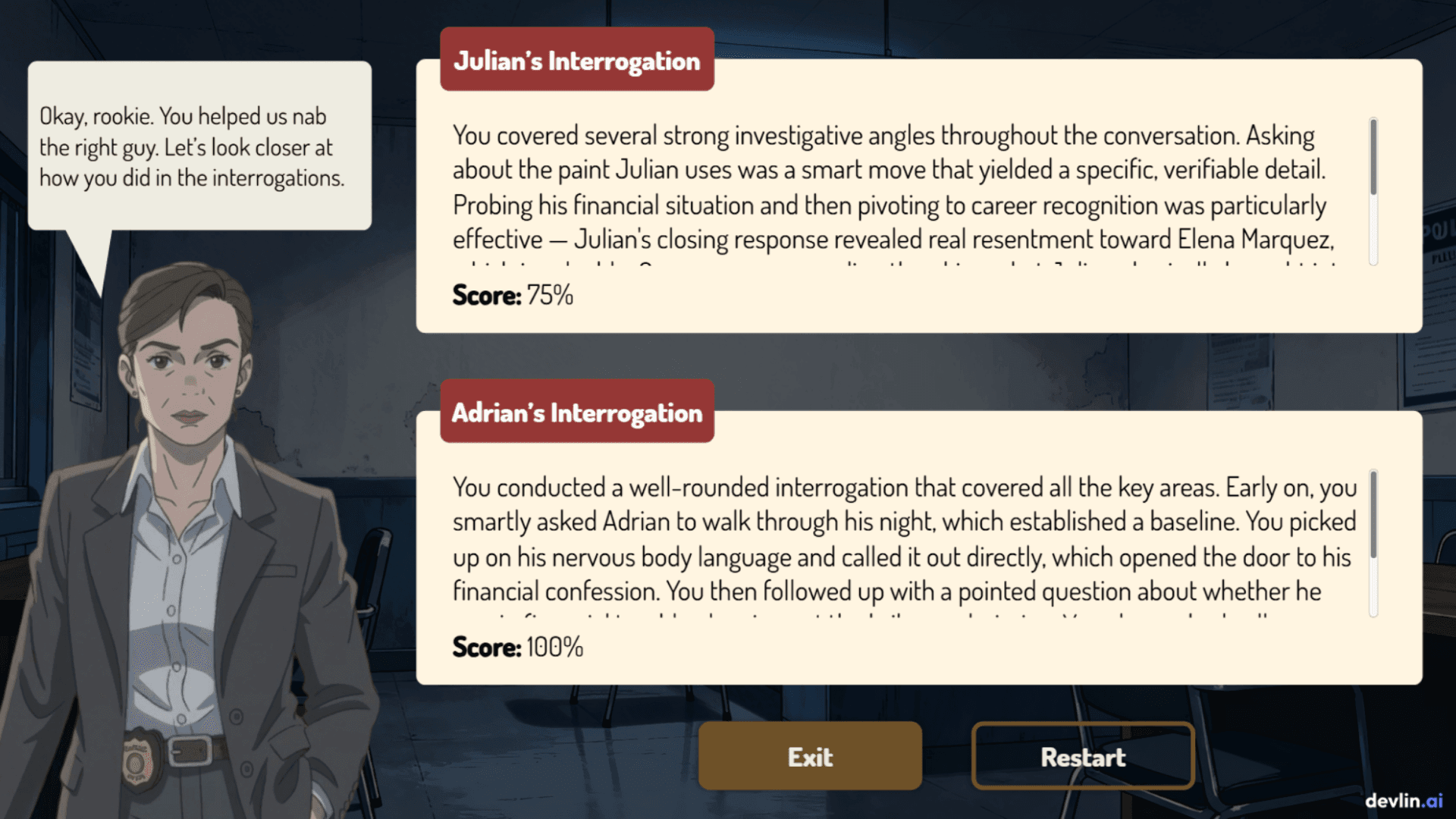
Because every learner can ask different questions, generic feedback wouldn’t adequately reflect their performance. I used devlin.ai to generate feedback based on the learner’s actual conversations, focusing on how effectively they asked relevant questions, explored suspicious details, followed up on inconsistencies, gathered supporting evidence, and used that information to reach a conclusion. Rather than simply telling learners whether they were right or wrong, the feedback helps them reflect on the quality of their investigative process.
ResultsMeasuring purposeful questioning
Because Brushstrokes & Lies is a conceptual project, the next step would be to pilot the simulation with a small group of adult learners. I’d evaluate whether they ask purposeful, targeted questions rather than broad or repetitive ones, recognize inconsistencies without jumping straight to conclusions, and can explain how the evidence they gathered actually supports the suspect they chose.
I’d also review the AI-generated feedback data across multiple learners to spot common reasoning patterns — whether people accept a suspect’s first answer too quickly, fixate on one suspect early, or accuse before gathering enough support. Success wouldn’t be measured by how many learners name the correct culprit, but by whether their questioning and reasoning improve: asking better follow-ups, weighing multiple sources, and building a defensible case rather than a guess.
TakeawaysWhat I took away
One of the most important decisions in this project was letting learners ask their own questions instead of choosing from a menu. A traditional branching scenario would require me to predict every useful line of inquiry in advance; the AI-powered conversations give learners real freedom while keeping the investigation anchored to the same evidence and objectives.
This project also reinforced something I believe strongly: the narrative and the instructional purpose can serve different jobs. The art heist creates curiosity and motivation, but the real practice comes from deciding what to ask, evaluating the answers, and building a defensible conclusion. The story makes it engaging; the questioning makes it instructional.
The animated visual style came from a workflow I built using Magnific for character and environment animation, refined in Adobe Premiere Pro into seamless loops for Storyline. Enough people asked about that process that I turned it into a YouTube tutorial, “I Made These AI Animated Videos in Minutes… You Can Too!”
Ultimately, this project showed me that AI can support genuine critical-thinking practice without becoming an unstructured free-for-all. Every learner investigates differently, but the conditional evidence and evaluation criteria keep the experience focused on purposeful questioning and evidence-based reasoning.
Think you can crack the case?
Step into the investigator’s role, question both suspects, and build your case before you accuse.